Tuesday, May 29, 2018

Only a Few Got It Right at Sohn 2017 in Hong Kong. Here��s Who

Only a handful of clear winners stand out among the hedge-fund managers and short-sellers who pitched their top trade ideas at the Sohn Investment Conference in Hong Kong a year ago.

The majority of investment picks unveiled at the annual event on June 7, 2017 would have lost money in a year marked by concerns over rate hikes and rising trade tensions, in some cases giving up gains after a promising start. Flowering Tree Investment Management’s Rajesh Sachdeva, SC Lowy Financial (HK)’s Michel Lowy and Oasis Management Co.’s Seth Fischer were among the few managers whose ideas would have made investors money had they acted on the tip on the day they were made and held on to them until now.

#lazy-img-328125011:before{padding-top:66.64999999999999%;}

Seth Fischer

Photographer: Justin Chin/Bloomberg

Bearish calls by short-seller Carson Block and hedge fund manager Dan David backfired as the Hong Kong stocks they targeted rallied.

As some of the region’s top managers gather again on Wednesday in Hong Kong, here’s a look at how some of those ideas fared:

Rajesh Sachdeva, CEO and founder of Flowering Tree Investment

Investment thesis: Sachdeva bet on India’s growing middle class and urbanization trend, which he said would augur well for "organized" home improvement retailers. He described Shankara Building Products Ltd. as the emerging Home Depot Inc. of India and said the firm could boost revenue by 18 percent to 20 percent in each of the next three to five years.

#lazy-img-328056213:before{padding-top:56.25%;}

One year on: Shankara’s share price has surged by more than 160 percent since last June, as its growth accelerated and the company saw record same-store sales growth in the March quarter, said Sachdeva. Flowering Tree hasn’t sold a “single” share and the stock remains a core position, he said. “They’re still only scratching the surface of penetration and if they continue to execute, they can keep growing at the current pace for five-plus years.”

Seth Fischer, CIO of Oasis Management

Investment thesis: After presenting a surprise short idea the year before, Fischer turned to a bullish pick in 2017, saying Sony Corp. was undervalued and could rise as much as 39 percent. Fischer cited a massive turnaround under Kazuo Hirai, who was chief executive officer at the time, and said the company’s gaming, music and image-sensor businesses were strengths.

One year on: Sony’s stock has risen about 30 percent in the past year. Fischer says he “feels good” about the call. “Our thesis was that sometimes there is value in plain sight,” he says. “While the future of image sensors looks slightly less clear after weak iPhone X numbers, the gaming and music businesses continue to be strong.” In fact, Fischer says the company is still trading “at what we think is a very cheap multiple.” He says Oasis continues to hold the stock.

Michel Lowy, CEO of SC Lowy

Investment thesis: Lowy recommended shares of Peabody Energy Corp., the U.S. coal miner that emerged from bankruptcy protection. He said the stock would trade in the “high 30s” within three months, and saw as much as 60 percent upside in coming months.

One year on: The shares have jumped about 70 percent in the past year, and are trading above $41 per share. Lowy didn’t comment on whether he holds the shares.

Carson Block, chief investment officer of Muddy Waters

Investment thesis: Block tried a new strategy in shorting Hong Kong stocks last year. By telling media that he would announce a new target at Sohn Conference but not name it, Block triggered a flurry of speculation in the city’s equity market one day before the conference, causing selloffs in some mid- and small-cap stocks. Man Wah Holdings, the real short target which Block believed was a fraud, plunged 18 percent in two days.

One year on: Two days after being targeted, Man Wah published a statement denying Muddy Waters’ allegations and sent the shares up by record. It then conducted share buybacks to show management’s confidence. The stock recovered the losses soon and gained as much as 43 percent in the five months after the conference. They’ve since fallen, but are still up 18 percent from a year ago. Block declined to comment.

Dan David, CIO of FG Alpha Management

Investment thesis: The U.S. hedge fund said it was short-selling Hong Kong-listed Dali Foods Group Company Ltd., questioning the firm’s accounting. Shares of Dali Foods dropped 6.5 percent on that day.

One year on: It turned out to be another burnt short. A day after David’s call, Dali Foods rebounded after the company put out a statement saying the allegations were misleading. Riding on Hong Kong’s bull market, its shares rallied almost 40 percent in the past year. David didn’t reply to emails seeking comment.

Brandon Lin, CIO of SPQ Asia Capital

Investment thesis: Lin said U.S.-listed Chinese company Momo Inc. had morphed from an online dating platform into a top social networking service. He described it a "a strong buy, a strong leader in a terrific industry, and an attractive valuation,” adding that live video was a game-changer.

One year on: Momo’s share price has dropped 3.4 percent since last year’s conference. SPQ fund began buying Momo shares in late 2016 and it was the fund’s top winning trade in 2017 as shares soared, said Gregoire Dechy, SPQ’s chief operating officer. The fund started to cut holdings from mid-July, believing Momo’s growth had started to slow with quickly rising expenses, making the stock fairly priced, he said. The fund has since sold all of its Momo shares.

Wan Yuet Wei, CIO of Wei Capital Management

Investment thesis: Wan said shares of Chinese automaker Great Wall Motor Co. had the potential to surge as much as 100 percent in a best case scenario and could rise 48 percent even in a base-case scenario. She said her call was based on a product upgrade from China’s largest SUV-maker.

#lazy-img-328057613:before{padding-top:56.25%;}

One year on: Great Wall, a popular target of short-sellers in Hong Kong last year, has slumped almost 10 percent in the past year. The product upgrade was well received and drove strong performance initially, said Wan. That changed as it became evident that Great Wall was hanging on too long to old models that weren’t selling well, and China’s automakers lagged as trade pressure from the U.S. intensified, said Wan, adding that her fund has been trading the stock actively. She declined to say whether it continues to own the shares.

Eashwar Krishnan, managing partner of Tybourne Capital

Investment thesis: Rolls-Royce Holdings Plc.’s stock price might rise 85 percent by 2020 as the company boosted its share of a growing market for aircraft enginees, Krishnan said last year. It could double its market share in the next five to seven years, he added.

One year on: Rolls-Royce shares have declined about 2 percent in the past year after being hit by fears of cost overruns. The company has met or exceeded all business guidance and non-recurring expenses should be resolved by early 2019, said Krishnan. The costs don’t detract from its attractive growth in revenue, margins and cash flows for many years to come, he added. “We believe Rolls-Royce’s ability to generate cash is vastly under-estimated by the street,” he said. “Our estimates are significantly ahead of consensus and we continue to be shareholders.”

LISTEN TO ARTICLE 7:00 Share Share on Facebook Post to Twitter Send as an Email Print
Monday, May 28, 2018

How Much Does Warren Buffett Get From Social Security?

Warren Buffett is one of the wealthiest people in the world, with a stake in Berkshire Hathaway that's worth tens of billions of dollars. Buffett is just about the last person who needs the financial support that Social Security provides to retirees, but the Social Security program doesn't have any limits based on a recipient's financial means.

At age 87, Buffett has been eligible to receive Social Security for a long time. Thanks to the highly predictable way in which the Berkshire CEO gets paid, it's possible to run the numbers and get a rough idea of how much the Oracle of Omaha should be eligible to receive from Social Security.

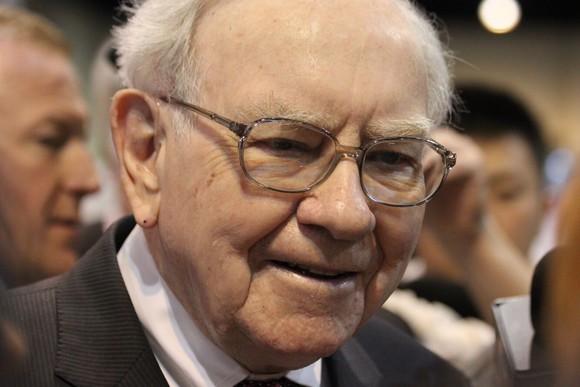
Warren Buffett, with some people out of focus behind him.

Image source: The Motley Fool.

Why you can guess what Buffett gets from Social Security

The reason why it's possible to get an idea of what Buffett gets in Social Security benefits is that the Social Security Administration bases its monthly retirement payments on a person's career earnings. The SSA looks at a person's 35 top-earning years after adjusting each annual amount for inflation, and it then calculates what's known as average indexed monthly earnings. From there, the figure goes through an SSA formula that determines a person's primary insurance amount. That's the base amount that a retiree is entitled to receive at full retirement age, but the actual payment can be higher or lower depending on whether the person claims benefits later or earlier than full retirement age.

Buffett has been very public in revealing his salaries over the years. In Berkshire's proxy statement for its annual meeting in 1999, the company revealed that Buffett had earned $100,000 each year for the past 18 years, dating back to 1981. That practice has continued to the present day.

Prior to that, reports are somewhat less complete. However, some secondary sources refer to Buffett getting a smaller $50,000 salary from Berkshire for at least a couple of years prior to 1981. Others point to Buffett's initial job working for Ben Graham's partnership, receiving a starting salary of $12,000 a year in 1954.

Fortunately, it's not necessary to know exactly how much Buffett made in order to calculate what he probably gets from Social Security. That's because the SSA has already done it for us, because Buffett is one of a select few people who has consistently earned more than the maximum amount on which Social Security charges payroll taxes. It wasn't until 2008 that the wage base limit on Social Security exceeded Buffett's $100,000 Berkshire salary, thus guaranteeing that for at least 28 years, Buffett earned the maximum amount. A $12,000 salary in the 1950s would have been well above the wage limit for Social Security at that time, as would a $50,000 salary in the 1970s. It's therefore reasonable to assume that Buffett's earnings record entitles him to the maximum benefit.

The choices Buffett would have had

Like anyone, Buffett had to choose when to take Social Security benefits. If he'd claimed at the earliest available age of 62 back in 1992, then the maximum initial monthly payment would have been $860 per month. Thanks to cost of living adjustments along the way, that number would work out to $1,527 per month in Social Security benefits today.

Based on his birth year of 1930, Buffett's full retirement age was 65. If he waited until then before claiming benefits, then he would have gotten an initial monthly amount of $1,199 in 1995. That would have grown to $1,961 per month today.

Yet Buffett didn't really have much need to collect Social Security, and so it would have been reasonable for him to wait until the latest possible age of 70 before claiming. If he did so, then he would have been entitled to an initial monthly benefit of $1,752 in 2000. Over the following 18 years, cost of living adjustments would have boosted that amount to $2,562 per month.

The interesting thing about Buffett and Social Security

Buffett has ideas about dealing with Social Security's financial issues. One solution he's suggested has been to eliminate the wage base limit on Social Security taxes, thereby increasing the amount of revenue that the program brings in. In particular, those executives who make millions of dollars in salaries and other compensation would see the amount they had to pay into Social Security through payroll taxes skyrocket.

Yet what's somewhat ironic about that idea is that Buffett wouldn't have had to pay markedly more in payroll taxes under his proposal. Taxes on the full $100,000 would have amounted to $6,200 annually since 1990, with lower tax rates having applied in earlier years. Yet because he kept his salary low compared to his peers, he never would've had to pay the gargantuan taxes that executives with seven- or eight-figure salaries would pay under his proposal.

It's amusing to think of the billionaire investor getting a $2,562 check from Social Security deposited into his bank account every month. Yet Buffett's experience shows how every worker, rich or poor, stands to benefit from the Social Security program.

Sunday, May 27, 2018

Gruss & Co Inc Buys iShares MSCI China ETF, CBS Corp, ProShares UltraShort Lehman 20 Year Treasury,

West Palm Beach, FL, based Investment company Gruss & Co Inc buys iShares MSCI China ETF, CBS Corp, ProShares UltraShort Lehman 20 Year Treasury, Walmart Inc, iShares MSCI Japan Index Fund, Vornado Realty Trust, Walt Disney Co, sells Facebook Inc, Biogen Inc, Schlumberger, Alphabet Inc, Alphabet Inc during the 3-months ended 2018-03-31, according to the most recent filings of the investment company, Gruss & Co Inc. As of 2018-03-31, Gruss & Co Inc owns 32 stocks with a total value of $92 million. These are the details of the buys and sells.

New Purchases: MCHI, CBS, TBT, WMT, EWJ, VNO, Added Positions: DXJ, DIS, FRBK, P, Reduced Positions: FB, AMZN, BIIB, SLB, GOOG, GOOGL, GOGL, BX, WPC, BXMT, Sold Out: TMUS, OSG, CELG, IP,

For the details of GRUSS & CO INC's stock buys and sells, go to http://www.gurufocus.com/StockBuy.php?GuruName=GRUSS+%26+CO+INC

These are the top 5 holdings of GRUSS & CO INCAmazon.com Inc (AMZN) - 11,300 shares, 17.71% of the total portfolio. Shares reduced by 14.07%Apple Inc (AAPL) - 42,250 shares, 7.68% of the total portfolio. SPDR Gold Trust (GLD) - 52,500 shares, 7.15% of the total portfolio. WisdomTree Japan Hedged Equity Fund (DXJ) - 117,500 shares, 7.13% of the total portfolio. Shares added by 17.50%Microsoft Corp (MSFT) - 70,500 shares, 6.97% of the total portfolio. New Purchase: iShares MSCI China ETF (MCHI)

Gruss & Co Inc initiated holding in iShares MSCI China ETF. The purchase prices were between $65.39 and $76.72, with an estimated average price of $70.97. The stock is now traded at around $69.09. The impact to a portfolio due to this purchase was 2.6%. The holding were 35,000 shares as of 2018-03-31.

New Purchase: CBS Corp (CBS)

Gruss & Co Inc initiated holding in CBS Corp. The purchase prices were between $49.27 and $60, with an estimated average price of $55.05. The stock is now traded at around $50.95. The impact to a portfolio due to this purchase was 2.23%. The holding were 40,000 shares as of 2018-03-31.

New Purchase: ProShares UltraShort Lehman 20 Year Treasury (TBT)

Gruss & Co Inc initiated holding in ProShares UltraShort Lehman 20 Year Treasury. The purchase prices were between $34.19 and $39.68, with an estimated average price of $37.13. The stock is now traded at around $37.49. The impact to a portfolio due to this purchase was 1.77%. The holding were 45,000 shares as of 2018-03-31.

New Purchase: Walmart Inc (WMT)

Gruss & Co Inc initiated holding in Walmart Inc. The purchase prices were between $85.42 and $109.55, with an estimated average price of $96.5. The stock is now traded at around $82.86. The impact to a portfolio due to this purchase was 1.45%. The holding were 15,000 shares as of 2018-03-31.

New Purchase: iShares MSCI Japan Index Fund (EWJ)

Gruss & Co Inc initiated holding in iShares MSCI Japan Index Fund. The purchase prices were between $58.28 and $64.67, with an estimated average price of $61.39. The stock is now traded at around $60.11. The impact to a portfolio due to this purchase was 1.31%. The holding were 20,000 shares as of 2018-03-31.

New Purchase: Vornado Realty Trust (VNO)

Gruss & Co Inc initiated holding in Vornado Realty Trust. The purchase prices were between $65.15 and $77.32, with an estimated average price of $69.34. The stock is now traded at around $67.57. The impact to a portfolio due to this purchase was 0.73%. The holding were 10,000 shares as of 2018-03-31.

Added: Walt Disney Co (DIS)

Gruss & Co Inc added to a holding in Walt Disney Co by 25.00%. The purchase prices were between $98.54 and $112.47, with an estimated average price of $106.26. The stock is now traded at around $102.02. The impact to a portfolio due to this purchase was 0.33%. The holding were 15,000 shares as of 2018-03-31.

Sold Out: T-Mobile US Inc (TMUS)

Gruss & Co Inc sold out a holding in T-Mobile US Inc. The sale prices were between $57.69 and $65.6, with an estimated average price of $62.56.

Sold Out: Overseas Shipholding Group Inc (OSG)

Gruss & Co Inc sold out a holding in Overseas Shipholding Group Inc. The sale prices were between $1.7 and $2.93, with an estimated average price of $2.33.

Sold Out: Celgene Corp (CELG)

Gruss & Co Inc sold out a holding in Celgene Corp. The sale prices were between $84.98 and $109.14, with an estimated average price of $96.

Sold Out: International Paper Co (IP)

Gruss & Co Inc sold out a holding in International Paper Co. The sale prices were between $50.15 and $65.08, with an estimated average price of $58.67.


Here is the complete portfolio of GRUSS & CO INC. Also check out:

1. GRUSS & CO INC's Undervalued Stocks
2. GRUSS & CO INC's Top Growth Companies, and
3. GRUSS & CO INC's High Yield stocks
4. Stocks that GRUSS & CO INC keeps buying

Saturday, May 26, 2018

Top 10 Blue Chip Stocks To Invest In Right Now

tags:ITOT,CUBE,WIT,SHPG,KGC,SLP,CVTI,PRAA,ANSS,LGEAF, &l;p&g;&l;img class=&q;dam-image shutterstock size-large wp-image-737546929&q; src=&q;https://specials-images.forbesimg.com/dam/imageserve/737546929/960x0.jpg?fit=scale&q; data-height=&q;640&q; data-width=&q;960&q;&g; Shutterstock

The Federal Reserve&a;rsquo;s increased aggression over the past couple of years has finally come home to roost. The yield on the 10-year Treasury recently rocketed above 2.8% &a;ndash; a four-year high &a;ndash; while the 30-year cleared the 3% mark.

That&a;rsquo;s bad news for investors in many traditional dividend-paying blue chips.

The 10-year T-note might as well have been a &a;ldquo;high-yield&a;rdquo; savings account the past few years, offering almost laughable income of less than 1.4% as recently as 2016. That kind of environment gives investors &a;ldquo;yield goggles,&a;rdquo; making even no-growth stocks look attractive as long as they&a;rsquo;re paying out near 3%.

Just look at the performance of the &l;b&g;Consumer Staples Select Sector SPDR &l;/b&g;&a;ndash; a collection of companies such as &l;b&g;Procter &a;amp; Gamble&l;/b&g; and &l;b&g;Coca-Cola&l;/b&g; &a;ndash; against the 10-year Treasury rate. While the XLP has broadly grown, it&a;rsquo;s strongest when the T-note&a;rsquo;s yield is in decline, and the fund typically stagnates or declines when the Treasury begins to deliver more income.

Top 10 Blue Chip Stocks To Invest In Right Now: iShares Core S&P Total US Stock Mkt (ITOT)

Advisors' Opinion:
  • [By Todd Shriber, ETF Professor]

    Hundreds of exchange traded funds offer investors broad market exposure and many do so with nominal fees. Among the least expensive is the iShares Core S&P Total U.S. Stock Market ETF (NYSE: ITOT).

Top 10 Blue Chip Stocks To Invest In Right Now: CubeSmart(CUBE)

Advisors' Opinion:
  • [By Shane Hupp]

    DigiCube (CUBE) uses the hashing algorithm. It launched on March 12th, 2016. DigiCube’s total supply is 2,429,126,009 coins. DigiCube’s official Twitter account is @PurePoS. DigiCube’s official website is www.freestaking.com.

  • [By Joseph Griffin]

    DigiCube (CURRENCY:CUBE) traded 0.4% lower against the US dollar during the 24-hour period ending at 13:00 PM E.T. on May 25th. DigiCube has a total market cap of $363,954.00 and approximately $783.00 worth of DigiCube was traded on exchanges in the last 24 hours. During the last week, DigiCube has traded 0.6% higher against the US dollar. One DigiCube coin can currently be purchased for $0.0001 or 0.00000002 BTC on popular cryptocurrency exchanges.

Top 10 Blue Chip Stocks To Invest In Right Now: Wipro Limited(WIT)

Advisors' Opinion:
  • [By Lisa Levin] Companies Reporting Before The Bell Thermo Fisher Scientific Inc. (NYSE: TMO) is projected to report quarterly earnings at $2.4 per share on revenue of $5.63 billion. Ford Motor Company (NYSE: F) is expected to report quarterly earnings at $0.41 per share on revenue of $37.16 billion. Twitter, Inc. (NYSE: TWTR) is projected to report quarterly earnings at $0.11 per share on revenue of $605.26 million. Comcast Corporation (NASDAQ: CMCSA) is expected to report quarterly earnings at $0.59 per share on revenue of $22.75 billion. General Dynamics Corporation (NYSE: GD) is estimated to report quarterly earnings at $2.52 per share on revenue of $7.6 billion. The Boeing Company (NYSE: BA) is expected to report quarterly earnings at $2.58 per share on revenue of $22.24 billion. Anthem, Inc. (NYSE: ANTM) is estimated to report quarterly earnings at $4.91 per share on revenue of $22.52 billion. Viacom, Inc. (NASDAQ: VIAB) is projected to report quarterly earnings at $0.79 per share on revenue of $3.04 billion. Northrop Grumman Corporation (NYSE: NOC) is estimated to report quarterly earnings at $3.61 per share on revenue of $6.61 billion. Rockwell Automation Inc. (NYSE: ROK) is expected to report quarterly earnings at $1.81 per share on revenue of $1.66 billion. Wipro Limited (NYSE: WIT) is projected to report quarterly earnings at $0.07 per share on revenue of $2.15 billion. The Goodyear Tire & Rubber Company (NASDAQ: GT) is expected to report quarterly earnings at $0.46 per share on revenue of $3.82 billion. Owens Corning (NYSE: OC) is projected to report quarterly earnings at $0.97 per share on revenue of $1.62 billion. T. Rowe Price Group, Inc. (NASDAQ: TROW) is estimated to report quarterly earnings at $1.71 per share on revenue of $1.29 billion. Dr Pepper Snapple Group, Inc. (NYSE: DPS) is expected to report quarterly earnings at $1.04 per share on revenue of $1.57 billion. Sirius XM Holdings Inc. (NASDAQ: SI
  • [By Lisa Levin] Companies Reporting Before The Bell United Technologies Corporation (NYSE: UTX) is estimated to report quarterly earnings at $1.51 per share on revenue of $14.62 billion. The Coca-Cola Company (NYSE: KO) is expected to report quarterly earnings at $0.46 per share on revenue of $7.31 billion. Caterpillar Inc. (NYSE: CAT) is projected to report quarterly earnings at $2.07 per share on revenue of $11.93 billion. Verizon Communications Inc. (NYSE: VZ) is expected to report quarterly earnings at $1.11 per share on revenue of $31.22 billion. Lockheed Martin Corporation (NYSE: LMT) is estimated to report quarterly earnings at $3.42 per share on revenue of $11.28 billion. The Sherwin-Williams Company (NYSE: SHW) is projected to report quarterly earnings at $3.15 per share on revenue of $3.94 billion. Biogen Inc. (NASDAQ: BIIB) is expected to report quarterly earnings at $5.92 per share on revenue of $3.15 billion. 3M Company (NYSE: MMM) is estimated to report quarterly earnings at $2.52 per share on revenue of $8.26 billion. JetBlue Airways Corporation (NASDAQ: JBLU) is projected to report quarterly earnings at $0.2 per share on revenue of $1.75 billion. Eli Lilly and Company (NYSE: LLY) is expected to report quarterly earnings at $1.13 per share on revenue of $5.49 billion. Harley-Davidson, Inc. (NYSE: HOG) is estimated to report quarterly earnings at $0.88 per share on revenue of $1.25 billion. Corning Incorporated (NYSE: GLW) is expected to report quarterly earnings at $0.3 per share on revenue of $2.50 billion. Centene Corporation (NYSE: CNC) is projected to report quarterly earnings at $1.88 per share on revenue of $13.28 billion. The Travelers Companies, Inc. (NYSE: TRV) is estimated to report quarterly earnings at $2.77 per share on revenue of $6.75 billion. Wipro Limited (NYSE: WIT) is expected to report quarterly earnings at $0.07 per share on revenue of $2.16 billion. PACCAR Inc (NASDAQ: PCAR) is projected to

Top 10 Blue Chip Stocks To Invest In Right Now: Shire plc(SHPG)

Advisors' Opinion:
  • [By Benzinga News Desk]

    Takeda Pharmaceutical Co. moved closer to securing a $64 billion takeover of Shire PLC (NASDAQ: SHPG) after the target said it was willing to recommend that shareholders accept the Japanese firm’s latest proposal and extended a deadline to reach a definitive agreement: Link $

  • [By Motley Fool Staff]

    A month of back-and-forth has resulted in a Takeda�(NASDAQOTH:TKPHF) and Shire Plc (NASDAQ:SHPG) striking a deal to form the eight biggest drugmaker in the world. The merger's $62 billion cost, however, could be a problem, especially if it dings Takeda's credit rating.

  • [By Benzinga News Desk]

    Takeda Pharmaceutical Co. on Tuesday reached an agreement to buy Shire PLC (NASDAQ: SHPG), capping a months long battle for control of the European drugmaker and marking the biggest-ever overseas acquisition by a Japanese company: Link $

Top 10 Blue Chip Stocks To Invest In Right Now: Kinross Gold Corporation(KGC)

Advisors' Opinion:
  • [By Maxx Chatsko]

    Shares of Kinross Gold Corporation (NYSE:KGC) fell 14.3% today after the company announced first-quarter 2018 results. While the company delivered top-line growth compared to the year-ago period thanks to higher sales volumes and selling prices, it didn't trickle down to the bottom line. Instead, net income actually decreased 21% compared to the performance in the first quarter of 2017. It's the same sticking point Wall Street had with full-year 2017 results.

  • [By Dan Caplinger]

    Wednesday was a strong day on Wall Street, and major benchmarks posted solid gains of around 1%. Market participants were generally happy about oil prices moving back into the $70s, hoping for a rebound in hard-hit areas of the country that had taken advantage of the triple-digit oil prices of the early 2010s by dramatically ramping up production of shale plays and similar opportunities. Yet even with the generally favorable mood, some stocks weren't able to join the rally. Kinross Gold (NYSE:KGC), Weibo (NASDAQ:WB), and Middleby (NASDAQ:MIDD) were among the worst performers on the day. Here's why they did so poorly.

  • [By Max Byerly]

    Shares of Kinross Gold (TSE:K) (NYSE:KGC) have received a consensus recommendation of “Hold” from the seven research firms that are presently covering the stock, MarketBeat Ratings reports. One investment analyst has rated the stock with a sell recommendation, two have given a hold recommendation and two have given a buy recommendation to the company. The average 1 year price objective among brokerages that have updated their coverage on the stock in the last year is C$8.17.

  • [By Matthew DiLallo]

    Another major long-term project is Norte Abierto, which is also a 50/50 JV in Chile -- this time with Barrick Gold -- on one of the largest gold-copper discoveries in South America. Goldcorp just brought this project into its portfolio in 2017 after buying out�Kinross Gold's (NYSE:KGC) 25% stake as well as a 25% interest from Barrick Gold.

Top 10 Blue Chip Stocks To Invest In Right Now: Simulations Plus, Inc.(SLP)

Advisors' Opinion:
  • [By Stephan Byrd]

    Get a free copy of the Zacks research report on Simulations Plus (SLP)

    For more information about research offerings from Zacks Investment Research, visit Zacks.com

  • [By Ethan Ryder]

    Simulations Plus (NASDAQ:SLP) was upgraded by equities research analysts at ValuEngine from a “buy” rating to a “strong-buy” rating in a research report issued on Monday.

  • [By Stephan Byrd]

    Simulations Plus (NASDAQ:SLP) shares hit a new 52-week high and low during mid-day trading on Monday . The company traded as low as $18.55 and last traded at $18.35, with a volume of 49668 shares changing hands. The stock had previously closed at $18.20.

  • [By Shane Hupp]

    Simulations Plus (NASDAQ: SLP) and NetScout Systems (NASDAQ:NTCT) are both computer and technology companies, but which is the better stock? We will compare the two businesses based on the strength of their risk, earnings, valuation, profitability, dividends, institutional ownership and analyst recommendations.

Top 10 Blue Chip Stocks To Invest In Right Now: Covenant Transportation Group, Inc.(CVTI)

Advisors' Opinion:
  • [By Shane Hupp]

    ValuEngine upgraded shares of Covenant Transport (NASDAQ:CVTI) from a buy rating to a strong-buy rating in a research report sent to investors on Saturday morning.

  • [By Shane Hupp]

    Old Dominion Freight Line (NASDAQ: ODFL) and Covenant Transport (NASDAQ:CVTI) are both transportation companies, but which is the better stock? We will compare the two businesses based on the strength of their analyst recommendations, profitability, earnings, dividends, valuation, risk and institutional ownership.

Top 10 Blue Chip Stocks To Invest In Right Now: PRA Group, Inc.(PRAA)

Advisors' Opinion:
  • [By Dan Caplinger]

    Like many businesses, debt collection is a cyclical industry, and as a major player in that industry, PRA Group (NASDAQ:PRAA) is subject to the ups and downs of the economy. During good times, there aren't as many nonperforming loans for PRA Group to collect on. Only when times get tough do default rates move higher, spurring many creditors to turn their collections over to PRA.

  • [By Ethan Ryder]

    PRA Group (NASDAQ:PRAA) was upgraded by equities researchers at BidaskClub from a “sell” rating to a “hold” rating in a report released on Monday.

Top 10 Blue Chip Stocks To Invest In Right Now: ANSYS, Inc.(ANSS)

Advisors' Opinion:
  • [By Shane Hupp]

    GW&K Investment Management LLC grew its holdings in shares of Ansys (NASDAQ:ANSS) by 1.7% in the first quarter, according to the company in its most recent 13F filing with the Securities and Exchange Commission. The fund owned 223,126 shares of the software maker’s stock after acquiring an additional 3,664 shares during the quarter. GW&K Investment Management LLC owned about 0.27% of Ansys worth $34,962,000 at the end of the most recent quarter.

  • [By Stephan Byrd]

    Ansys (NASDAQ:ANSS) was downgraded by analysts at Zacks Investment Research from a buy rating to a hold rating. According to Zacks, “ANSYS delivered strong results for first-quarter 2018, wherein both the top and bottom lines fared better than the respective Zacks Consensus Estimates. Increasing demand for simulation particularly from industries like energy bodes well for ANSYS. We believe that robust product portfolio, expanding total addressable market improving enterprise penetration, collaborations with leading vendors, and strong balance sheet are the catalysts. Acquisitions like 3DSIM and OPTIS are not only enabling ANSYS to bring innovative solutions to the market but are also aiding it to enhance foothold in the competitive simulations market. However, its margin is expected to remain under pressure as ANSYS continues to invest on product development. Furthermore, adverse foreign currency exchange rates are expected to impede revenue growth in the near term as it generates significant revenues from international market.”

  • [By Shane Hupp]

    Ansys (NASDAQ:ANSS) Director James E. Cashman III sold 862 shares of the firm’s stock in a transaction on Tuesday, April 10th. The stock was sold at an average price of $158.00, for a total value of $136,196.00. The sale was disclosed in a filing with the Securities & Exchange Commission, which is accessible through this hyperlink.

Top 10 Blue Chip Stocks To Invest In Right Now: (LGEAF)

Advisors' Opinion:
  • [By SEEKINGALPHA.COM]

    Coherent's ELA deposition technology for LTPS backplane isn't used in OLED TVs, where LG (OTC:LGEAF) uses metal oxide backpanes. There was some worry by analysts whether that technology could migrate to the smartphone panel market which CEO Ambroseo could not dispel entirely, but he argued that it has not been demonstrated suitable for handsets or battery-powered devices at this point.

Thursday, May 24, 2018

Buy Micron (MU) Stock For Value & Growth Outlook

Shares of Micron (MU ) opened lower on Wednesday after two days of gains on the back of some major announcements, including a new deal with Intel (INTC ) . With that said, let’s dive into why the chip giant’s stock might be worth buying right now.

Stock Price Movement

Micron stock has skyrocketed 408% over the last two years, which crushes the S&P 500’s 31% climb. Shares of Micron also greatly outperformed its industry’s 99% surge, which includes the likes of Intel, Advanced Micro Devices (AMD ) , Broadcom (AVGO ) , Nvidia (NVDA ) , Texas Instruments (TXN ) , and more.

Over the last year, Micron stock has soared 101%, compared to its industry’s roughly 35% surge. Furthermore, shares of Micron have climbed over 21% in the last three months, while its broader industry is up just 3.5%.

Micron’s run of success might deter some investors since it could be hard to replicate this kind of growth. Still, despite Micron’s insane and sustained run, investors should note that the company closed Tuesday below its 52-week high. And there are plenty more reasons to be excited about Micron stock, including its growth prospects and current valuation picture.

Recent News

But before we jump into growth, it is worth taking a look at some company updates. Micron and Intel announced on Monday that they will produce and ship the “industry's first 4bits/cell 3D NAND technology,” while also noting that they made progress on the development of the third-generation 96-tier 3D NAND structure—which provides a 50% increase in layers.

The company also said it would repurchase $10 billion of outstanding common stock as part of a new plan to return at least 50% of free cash flow to stockholders starting in fiscal 2019. “The data-driven economy will transform nearly every industry, and drive secular growth in demand for memory and storage," CEO Sanjay Mehrotra said.

Furthermore, Micron upped its guidance and now expects current quarter revenues to be in the range of $7.7 billion to $7.8 billion, up from its previous guidance of $7.2 billion to $7.6 billion.

Growth Outlook

Our current Zacks Consensus Estimates don’t necessarily reflect Micron’s updated quarterly revenue outlook just yet. But investors will be pleased to note that our current estimate of $7.44 billion, would mark a nearly 34% climb from the year-ago period. Looking a bit further ahead, the company’s full-year revenues are projected to soar nearly 44% to reach $29.22 billion.

Transitioning to the other end of the income statement, Micron’s quarterly earnings are projected to skyrocket roughly 81% to touch $2.93 per share. And if that growth projection didn’t impress investors enough, Micron’s full-year earnings are expected to soar over 127% to reach $11.27 per share.

Valuation

Now that we have covered Micron’s recent business updates, stock price movement, and growth outlook, it’s time to move onto its current valuation, which is impressive, to say the least.

Coming into Wednesday, Micron stock was trading at 5.8X forward 12-month Zacks Consensus EPS estimates, which marks a massive discount compared to its industry’s 13.2X. Over the last two years, Micron stock has traded as high as 32.5X and as low as 4.2X.


Micron stock has traded at a one-year median of 5.5X, against its industry’s 13.9X. Furthermore, Micron stock looks even cheaper compared to Nvidia’s one-year median of 45.6X. Therefore, investors should be able to say with confidence that Micron stock is a great value investment at the moment in a semiconductor market that is set to keep on booming.

The Hottest Tech Mega-Trend of All

Last year, it generated $8 billion in global revenues. By 2020, it's predicted to blast through the roof to $47 billion. Famed investor Mark Cuban says it will produce "the world's first trillionaires," but that should still leave plenty of money for regular investors who make the right trades early.

See Zacks' 3 Best Stocks to Play This Trend >>

Wednesday, May 23, 2018

11 midcaps fall 30-80% in 2018; experts say limit your exposure to 30%

It looks like the age-old saying, ��sell in May and go away�� might be coming true not just for May but�for 2018. The BSE Midcap index and BSE Smallcap index has plunged over 12 percent and�14 percent in 2018, respectively.

Both small�and midcap indices produced many multi-bagger stocks in 2017 but the New Year has started with its own set of challenges for the broader market. Market experts advise investors to stick to quality and limit their small and midcap exposure to 20-30 percent�of their portfolio.

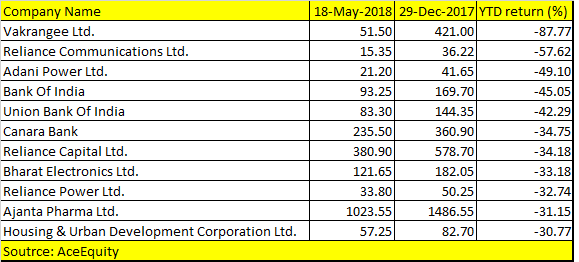
In�2018, 75 percent stocks in the BSE Midcap index�delivered negative returns. These include: Vakrangee (down 87 percent), Reliance Communications (down 57 percent), Adani Power (down 49 percent), Bank of India (down 45 percent) and Union Bank of India (down 42 percent).

The remaining stocks�that managed to buck the trend include: Mphasis (up 54 percent), L&T Infotech (up 37 percent), Gruh Finance (up 34 percent), Ashok Leyland (up 24 percent) and Biocon (up 20 percent).

related news Banking Q4 so far: 26 banks pile up NPAs worth Rs 7.31 lakh crore Technical View: Nifty forms small bullish candle; can go long with a stoploss below 10,500 Markets@Moneycontrol: Benchmark indices end mildly higher, SBI rises 4 percent

There are plenty of factors which have plagued the midcap space: high valuations, falling rupee versus the dollar, persistent selling by foreign investors, earnings failing to pick up as well as classification of mutual funds�by the Securities and Exchange Board of India (Sebi) led to some shuffle in mutual fund portfolios.

��The midcap and smallcap indices are quoting at an astronomically high price-to-earnings (P/E) ratio. On a trailing basis, the midcap index was at 50 times and smallcap index was at 100 times, which is not sustainable in a difficult macro environment,�� Hemang Jani, Head - Advisory, Sharekhan by BNP Paribas told Moneycontrol.

He was quick to add that investors need to maintain an exposure limit to avoid shocks to the portfolio.���Exposure of 20-30�percent is considered reasonable. We have to remember that there could be better performing companies within midcap/smallcap space where one can hold or add stocks during the volatile phase.��

Jani feels it makes sense for investors to exit not-performing companies and move into ones with better performance and quality management.

image (2)

The bull market in midcaps started after 2014 when the Narendra Modi government took charge�at the Centre. Since then, the broader market saw massive inflows into local mutual fund portfolios. Most funds inflows were diverted into mid- and smallcaps due to lack of largecap options.

A�lot has changed since 2014 and the mid-�and smallcap space seems to be losing momentum. ��After 2014, the midcap-to-Nifty ratio broke out of a decade cycle downtrend on the back of investors chasing midcaps,�� Elara Capital said in a report.

The brokerage advises investors to focus on largecaps from mid- and smallcaps. However, it was quick to add that bottom-fishing remains strong and hence one could see strong counter-rallies.

The story is similar�in the smallcap space as 80 percent of stocks in the BSE Smallcap index posted negative return so far in 2018. These include:�Gitanjali Gems (down 92 percent), Diamond Power (down 87 percent), Electrosteels Steels (down 81 percent), Orient Paper (down 75 percent) and SRS Real Infrastructure (down 80 percent).

If we look at the stocks which managed to outperform the index, only 20 percent bucked the trend. These include: Excel Industries (up 102 percent), Nelco (up 77 percent), Firstsource Solutions (up 73 percent) and Mindtree (up 64 percent).

Tuesday, May 22, 2018

Wells Fargo Cuts 22 Jobs in Currency Trading

Wells Fargo & Co.’s foreign-exchange business cut 22 salespeople, according to a person briefed on the matter, the latest casualties of a slump in market activity.

Affected employees worked in locations including St. Louis and Atlanta, where the bank is consolidating operations elsewhere, the person said. Some staff are being moved to other offices, while others leave the company, the person said.

“Wells Fargo is fully committed to our FX business,” Jessica Ong, a spokeswoman for the San Francisco-based bank, said Monday in an emailed statement. “We continually evaluate our resources and staffing levels to ensure we are aligned to meet the needs of our customers as part of normal course of business.” She confirmed that operations in St. Louis and Atlanta are being moved.

The $5.1 trillion-a-day currency market has been plagued by low volatility, even amid heightened trade and geopolitical tensions over the past year, making it harder to eke out profits on swings. In March, the lender said it’s responding to queries from government agencies into its foreign-exchange business. Several employees left the unit last year over a transaction for a client, the company said at the time.

Read more on Wells Fargo: CEO Sloan says bank to boost auto lending

LISTEN TO ARTICLE 1:11 Share Share on Facebook Post to Twitter Send as an Email Print

Monday, May 21, 2018

Quotient Limited: Buy This Industry Disruptor

Quotient Limited (QTNT) is breaking out higher due to positive developments in its MosaiQ platform. The company successfully finished a verification/validation phase for its platform and is on its way to commercialization in the large, highly developed reagent market. Its share price has broken a multi-year downtrend on the news and looks to advance further in coming quarters. I am buying stock in this name as its disruptive technology looks to fuel more investor optimism.

Fundamental Narrative

QTNT is attractively positioned in the current market environment as its MosaiQ platform gains traction, revolutionizing the healthcare industry, while its other commercial operations continue to strengthen. The company is a commercial-stage diagnostics firm, developing, manufacturing, and commercializing conventional reagent products used for blood grouping in the transfusion diagnostics market worldwide. It is also developing MosaiQ, a proprietary technology platform, which provides tests for blood grouping and serological disease screening.

Product revenues in its most recent quarter came in at $5.7 million, an increase of 17% from the previous year. The increase in product sales was mainly attributable to growth in revenues from both OEM customers and incremental direct and distributor sales, according to its earnings call. OEM sales of $3.8 million grew 9% year-over-year and represented 68% of product sales. The increase was primarily driven by better pricing, increased sales to existing customers, and the impact of recently launched new products. Direct and distributor sales of $1.8 million increased 36% year-over-year and represented 32% of product sales.

The company's initial blood grouping MosaiQ microarray recently finished a verification/validation phase and has started field trials in Europe, according to Seeking Alpha. Its results of previously disclosed V&V results implied overall concordance of 99.8% for antigen typing on the MosaiQ platform. The MosaiQ IH microarray antibody detection requirement is to be 95% concordant with predicate technology, signaling a success of its current phase.

Having established the need to modify the MosaiQ manufacturing process, the principal area of focus for QTNT has been on performance of the antigen typing array, according to management. In studies to date comparing results generated using MosaiQ following the process modifications with predicate technologies, performance of the antigen typing array has shown broad-based improvement. Specifically, these studies have demonstrated significant and consistent improvement in the performance of the little C assay, with concordance results at levels never seen before in MosaiQ.

When approved for the market, MosaiQ will be uniquely placed to deliver the benefits of high throughput automation with the ease of use and cost efficiency of a single universal testing platform, providing the capability to fully characterize and screen donated blood in a single testing event, according to management. Development efforts for its initial products are essentially complete, with management confident about the ability of MosaiQ to perform in a customer setting.

As MosaiQ progresses towards commercialization, management continues to believe it will transform the field of transfusion diagnostics and will be well placed to disrupt existing and aging testing platforms, according to its earnings call. MosaiQ will also advance patient care at no extra cost to the health care system. It will be the first fully automated testing platform capable of delivering a comprehensive characterization of donor and patient blood, allowing for the better matching of donor blood to patients. It will also eliminate the need for routine and expensive manual testing for blood grouping, while offering a single unified testing platform, simplifying testing processes and consumable requirements, according to management.

MosaiQ has the potential to offer major efficiencies and lower costs for testing laboratories worldwide. The target addressable market for MosaiQ is both highly developed, and at over $3.4 billion reagent spend per annum, it is substantial, according to its earnings call. Near term, management is focused on execution of the remaining steps to bring MosaiQ to market in advance of commercial launch in Europe this year and in the United States thereafter.

As far as financing is concerned, the company recently completed a $40 million equity funding through a private placement mechanism. The combination of these funds, together with the planned sale and leaseback of the BioCampus facility, provides the necessary funding to bring QTNT to future milestones in its near-term funding plan. This includes a further $36 million drawdown on its senior debt facility and the potential inflow of up to $49 million of capital resulting from the exercise of warrants sold in conjunction with its recent equity funding, according to its earnings call. With these elements in place, management anticipates being fully funded through early commercialization as the major development funding and capital requirements of recent years moderate.

The company is making significant progress with MosaiQ, leading investors to bid its share price higher in recent weeks. Further progress in its fundamental operations should fuel further share price gains in coming quarters.

Price Action

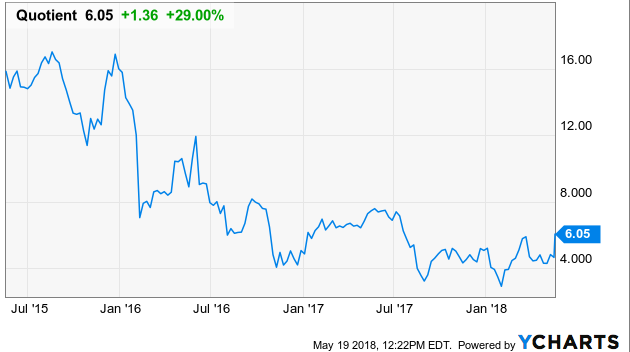
QTNT looks to be forming a bottoming pattern after years of decline. Positive developments in its MosaiQ technology could potentially be an industry disruptor, having major commercial success in coming years. Investors have bid its share price higher on this expectation.

The company's share price looks to be forming a bottoming pattern near the $4-6 range. Its breakout last week above the $5 level was significant as this area had acted as strong resistance in recent years.

Conclusion

QTNT is breaking out higher due to positive developments in its MosaiQ platform. The company successfully finished a verification/validation phase for its platform and is on its way to commercialization in the large, highly developed reagent market. Its share price has broken a multi-year downtrend on the news and looks to advance further in coming quarters. I am buying stock in this name as its disruptive technology looks to fuel more investor optimism.

Markets move quickly. To take advantage of the highs and lows - especially in today's volatile environment - you need a strategy that's nimble and flexible. My approach is both, and it enables me to move in and out of assets and sectors while continually generating double-digit annualized returns. Sign up for Absolute Returns today to see how I manage my portfolio in the continuously changing market environment. Many believe absolute returns and beating the market are mere fiction, but I assure you they're not. See for yourself how you can benefit from my approach, and how your portfolio can profit, regardless of market conditions.

Disclosure: I am/we are long QTNT.

I wrote this article myself, and it expresses my own opinions. I am not receiving compensation for it (other than from Seeking Alpha). I have no business relationship with any company whose stock is mentioned in this article.

Sunday, May 20, 2018

Analysts Set HCA Healthcare Inc (HCA) Price Target at $107.29

Shares of HCA Healthcare Inc (NYSE:HCA) have been given a consensus recommendation of “Hold” by the twenty-six ratings firms that are covering the stock, MarketBeat Ratings reports. Four research analysts have rated the stock with a sell rating, six have given a hold rating and sixteen have issued a buy rating on the company. The average 1 year price target among brokerages that have issued a report on the stock in the last year is $107.29.

A number of equities research analysts have weighed in on HCA shares. Zacks Investment Research lowered HCA Healthcare from a “hold” rating to a “sell” rating in a research note on Wednesday, January 24th. William Blair restated a “hold” rating on shares of HCA Healthcare in a research note on Wednesday, January 24th. Wells Fargo started coverage on HCA Healthcare in a research note on Tuesday, January 30th. They set an “outperform” rating and a $116.00 price objective for the company. Cantor Fitzgerald restated a “buy” rating and set a $115.00 price objective on shares of HCA Healthcare in a research note on Tuesday, January 30th. Finally, Piper Jaffray restated a “hold” rating and set a $101.00 price objective on shares of HCA Healthcare in a research note on Tuesday, January 30th.

Get HCA Healthcare alerts:

In other news, insider Charles J. Hall sold 49,882 shares of HCA Healthcare stock in a transaction that occurred on Wednesday, February 21st. The stock was sold at an average price of $101.29, for a total value of $5,052,547.78. Following the completion of the transaction, the insider now owns 62,048 shares in the company, valued at approximately $6,284,841.92. The sale was disclosed in a legal filing with the SEC, which is available through this hyperlink. Also, major shareholder Thomas F. Frist, Jr. bought 28,650 shares of the firm’s stock in a transaction dated Tuesday, February 20th. The stock was purchased at an average price of $101.07 per share, with a total value of $2,895,655.50. Following the transaction, the insider now owns 389,855 shares in the company, valued at approximately $39,402,644.85. The disclosure for this purchase can be found here. 2.80% of the stock is currently owned by company insiders.

Large investors have recently added to or reduced their stakes in the stock. We Are One Seven LLC acquired a new position in HCA Healthcare during the 4th quarter valued at approximately $110,000. Parallel Advisors LLC boosted its position in HCA Healthcare by 76.2% during the 4th quarter. Parallel Advisors LLC now owns 1,337 shares of the company’s stock valued at $117,000 after purchasing an additional 578 shares during the period. Salem Investment Counselors Inc. acquired a new position in HCA Healthcare during the 4th quarter valued at approximately $130,000. Verition Fund Management LLC acquired a new position in HCA Healthcare during the 4th quarter valued at approximately $205,000. Finally, Bronfman E.L. Rothschild L.P. boosted its position in HCA Healthcare by 108.0% during the 4th quarter. Bronfman E.L. Rothschild L.P. now owns 2,425 shares of the company’s stock valued at $213,000 after purchasing an additional 1,259 shares during the period. Institutional investors and hedge funds own 72.52% of the company’s stock.

HCA Healthcare traded down $0.27, reaching $102.83, during mid-day trading on Thursday, according to MarketBeat Ratings. 1,214,131 shares of the company’s stock traded hands, compared to its average volume of 2,139,368. HCA Healthcare has a 1-year low of $71.18 and a 1-year high of $106.84. The company has a quick ratio of 1.17, a current ratio of 1.39 and a debt-to-equity ratio of -7.13. The firm has a market cap of $35.92 billion, a PE ratio of 15.60, a price-to-earnings-growth ratio of 1.00 and a beta of 0.48.

HCA Healthcare (NYSE:HCA) last issued its quarterly earnings data on Tuesday, May 1st. The company reported $2.33 earnings per share for the quarter, beating analysts’ consensus estimates of $2.07 by $0.26. HCA Healthcare had a negative return on equity of 55.50% and a net margin of 5.96%. The firm had revenue of $11.42 billion during the quarter, compared to analyst estimates of $11.29 billion. During the same quarter last year, the firm earned $1.74 EPS. HCA Healthcare’s quarterly revenue was up 7.5% on a year-over-year basis. analysts anticipate that HCA Healthcare will post 8.83 earnings per share for the current year.

The company also recently announced a quarterly dividend, which will be paid on Friday, June 29th. Stockholders of record on Friday, June 1st will be given a $0.35 dividend. The ex-dividend date of this dividend is Thursday, May 31st. This represents a $1.40 annualized dividend and a dividend yield of 1.36%. HCA Healthcare’s payout ratio is 21.24%.

HCA Healthcare Company Profile

HCA Healthcare, Inc, through its subsidiaries, provides health care services. The company operates general, acute care hospitals that offer medical and surgical services, including inpatient care, intensive care, cardiac care, diagnostic, and emergency services; and outpatient services, such as outpatient surgery, laboratory, radiology, respiratory therapy, cardiology, and physical therapy services.

Analyst Recommendations for HCA Healthcare (NYSE:HCA)

Saturday, May 19, 2018

Why Nordstrom Inc. Stock Tumbled Today

What happened

Shares of�Nordstrom Inc.�(NYSE:JWN) were heading lower today after the department store chain turned in a disappointing first-quarter earnings report with comparable sales coming in lower than expected. As a result, the stock was down 9.2% as of 11:17 a.m. EDT.�

A mock-up of the upcoming Nordstrom store in Manhattan

Image source: Nordstrom.

So what

Comparable sales for the period, which include e-commerce, rose just 0.6%, worse than estimates of 1.1%, as results in the off-price division were particularly disappointing, increasing just 0.4%, compared to 2.3% growth a year ago. Total revenue in the quarter increased 5.8% to $3.56 billion, beating estimates of $3.46 billion; however, adjusted for the shift in the company's Nordstrom Rewards loyalty event, the figure would have been about even with expectations.�

The slowing growth in the company's off-price division is concerning as the retailer continues to add more Rack stores, which has been seen as a main avenue for growth for the company. However, with comps decelerating in that area, the company may want to reconsider that expansion strategy.�

On the bottom line, adjusted earnings per share increased from $0.43 to $0.51, topping estimates for $0.44. In spite of that beat, investors remained focused on sales performance as the market has been skeptical of the department store sector.�

Digital sales were up 18% in the quarter and now make up 29% of total sales.

Now what

Nordstrom maintained its comparable sales outlook for the year, calling for a 0.5%-1.5% increase in that category, and lifted its earnings-per-share forecast slightly from $3.30-$3.55 to $3.35-$3.55.�

Given that improved outlook, the sell-off seems surprising. Nordstrom is a stronger business than the market is giving it credit for and is in a better position than many of its peers. Today's slide could be a good buying opportunity.